Key Points
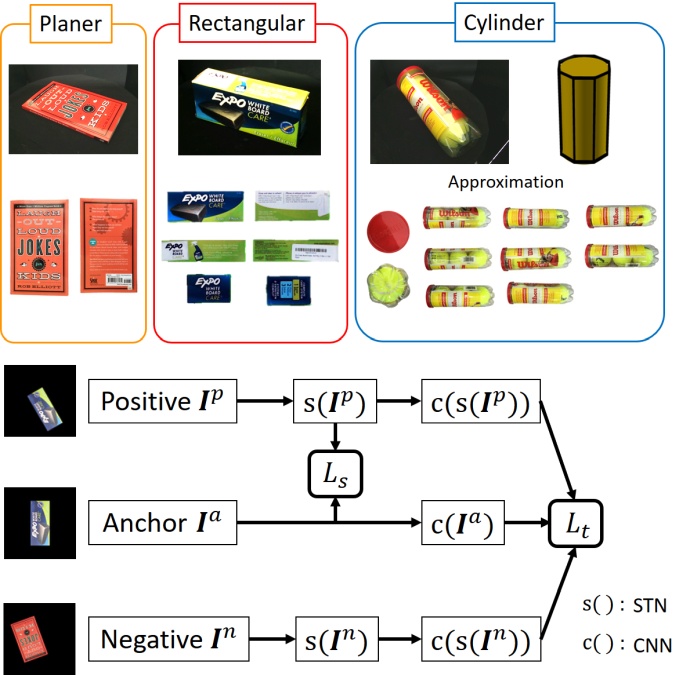
We jointly learn a spatial transformation that aligns an object's canonical plane to a consistent pose and features that distinguish object classes. Object recognition and pose estimation are learned using object class labels, without explicitly labeling pose parameters.
Abstract
This research aims to recognize an object in an image and also estimate its orientation. Training such a system usually requires labels describing both the object's identity and its pose, and recording detailed pose values takes time. We proposed a method that learns from object-class labels without explicitly labeling those pose values.
The method uses a flat reference surface on the object. It jointly learns how to transform the surface's appearance into a consistent pose and how to distinguish object classes. Images of the same class are encouraged to have similar features, while different classes remain distinguishable. This connects image alignment with recognition.
On a public dataset, the method recognized objects more accurately and estimated their poses with less error than simply using image-triplet learning or an image-transformation network. It therefore addresses recognition and pose estimation together while reducing the work needed to prepare training labels.
Publications
- Kouki Ueno, Go Irie, Masashi Nishiyama, Yoshio Iwai,
Weakly Supervised Triplet Learning of Canonical Plane Transformation for Joint Object Recognition and Pose Estimation, Proceedings of IEEE International Conference on Image Processing (ICIP), pp. 2476 - 2480, September 2019. - 上野 高貴, 西山 正志, 岩井 儀雄,
物体検出のための側面を用いた訓練サンプル生成による撮影枚数の削減,
精密工学会誌, vol. 84, no. 12, pp.1041 - 1049, December 2018.
