Key Points
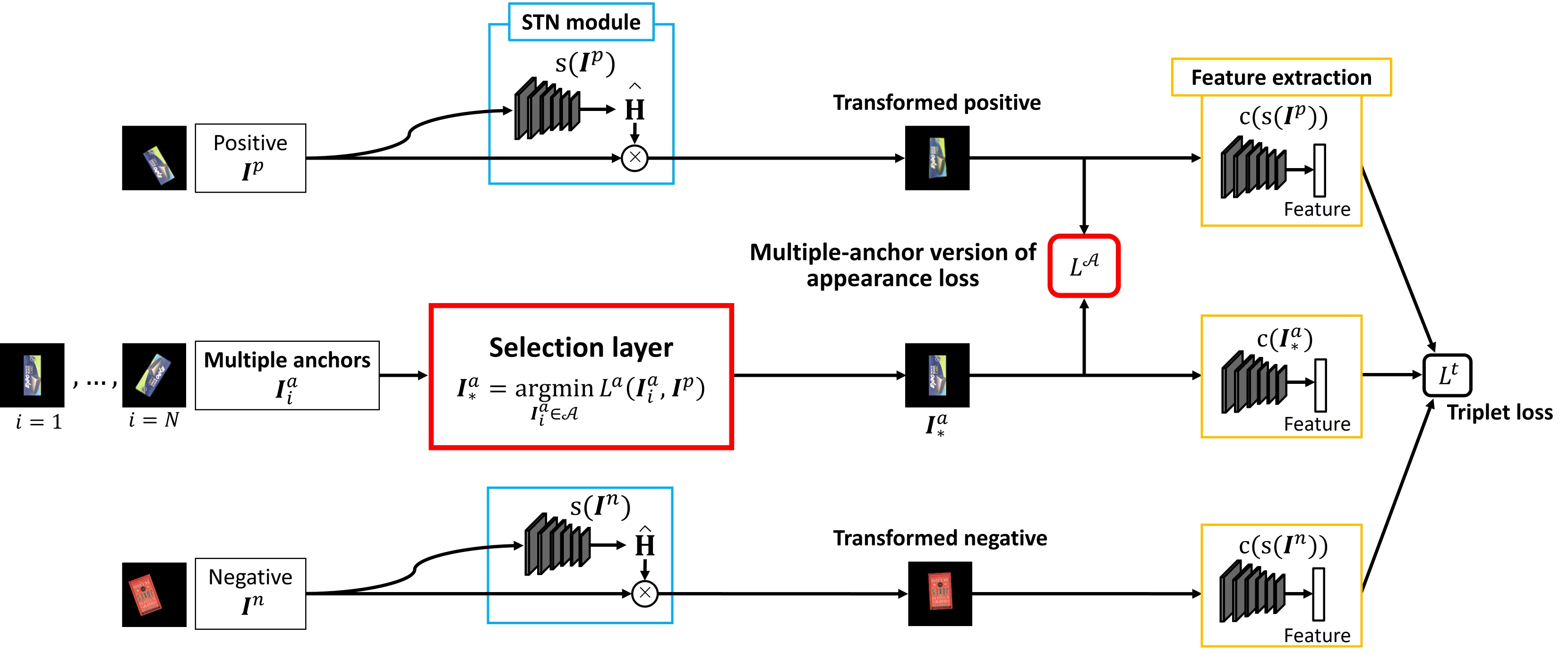
We prepare several anchor images showing an object in different reference poses and automatically select a suitable anchor for each input image during training. Reducing the pose difference from the reference improves both object recognition and pose estimation.
Abstract
To pick a product from a shelf, a robot needs to know both what the product is and which way it is facing. Learning these tasks from images usually requires many examples labeled with the correct object type and orientation. Preparing accurate orientation labels takes considerable effort.
In our earlier work, we trained a model to recognize an object and estimate its orientation by comparing an input image with a reference image of the same object. This avoided assigning a numerical orientation label to every training image. However, estimation became less accurate when the two images showed very different orientations. Here, we prepare several reference images with different orientations and add a mechanism that automatically selects a suitable reference during training.
We tested the method on three benchmark datasets for product-picking scenarios. It identified object types and estimated orientations more accurately than the existing methods used for comparison. The results show that multiple reference images help the model handle larger differences in how an object appears.
Publications
- Shunsuke Yoneda, Kouki Ueno, Go Irie, Masashi Nishiyama, Yoshio Iwai,
Joint Object Recognition and Pose Estimation using Multiple-anchor Triplet Learning of Canonical Plane,
Pattern Recognition Letters (PRL), Vol. 152, pp. 372 - 381, December 2021.
