Key Points
How do others perceive the impression an applicant wants to convey? We use simulated interview videos to study where people look and how they rate their impressions. By considering both the applicant’s intention and the viewer’s response, we explore how impressions are conveyed and how they change over time.
Abstract
In an interview, actions such as nodding and posture can shape an impression, along with what a person says. However, the impression someone wants to convey does not always match the impression another person forms. Impressions can also differ between viewers and change during an interview. This research explores how these impressions are conveyed.
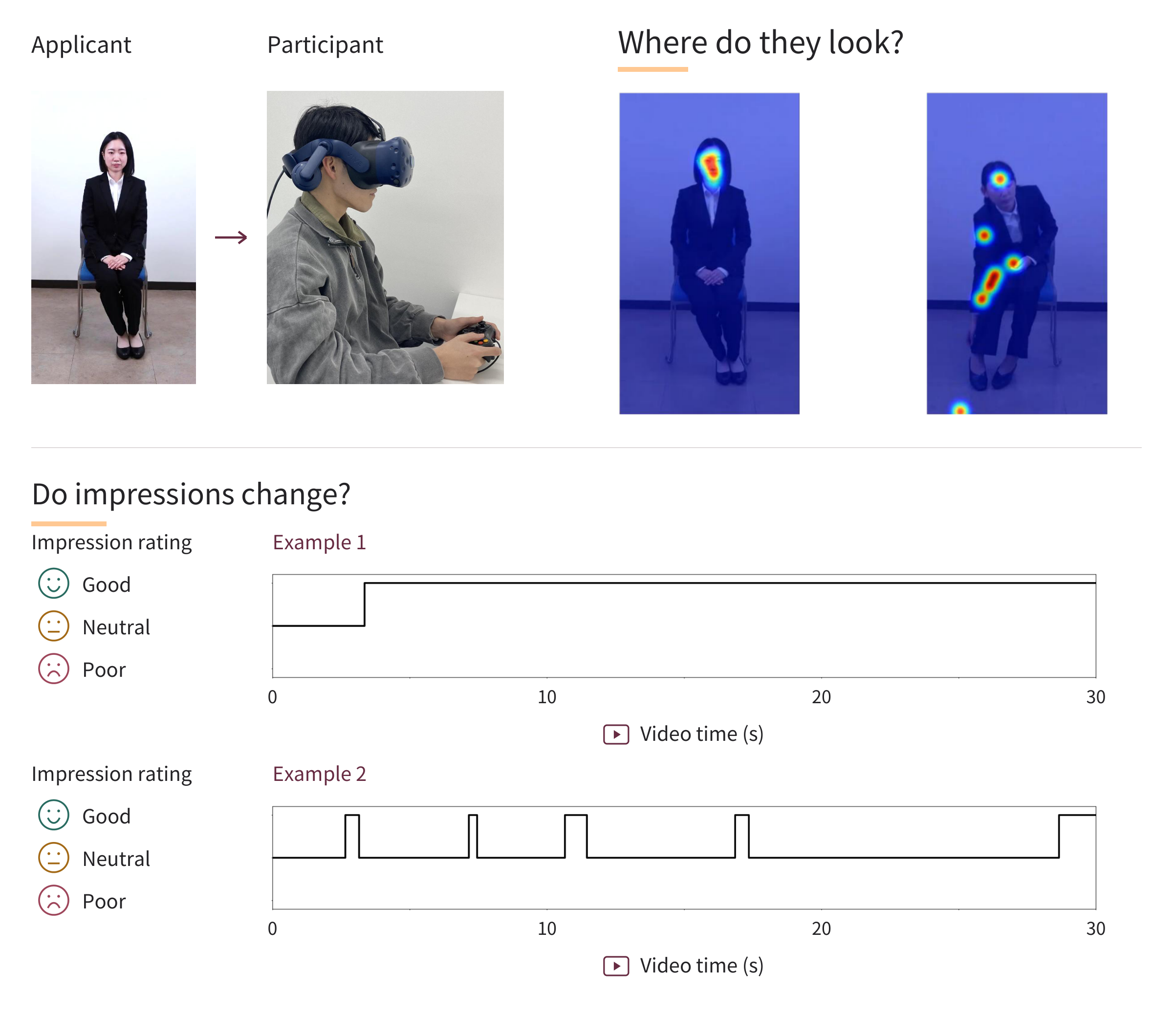
We use 30-second videos of a person playing an applicant who is listening to someone speak. Participants acting as interviewers watch and evaluate the videos. Alongside eye tracking, the assessments include ratings made after viewing and ratings that participants record with a controller as they watch. Gaze patterns and impression ratings provide different clues to the gap between the applicant’s intention and the viewer’s response, and to changes in impression over time.
1. The intended impression and the viewer’s response
Even when an applicant tries to convey a good impression, the viewer may not feel the same way. In our experiments, viewers tended to form impressions that matched the applicant’s intention, but there were also cases where the intended impression did not come across.
Viewers also differed in how their impressions changed while watching the same video. Looking at who forms an impression, when it forms, and how it changes helps us explore differences that the applicant’s intention alone cannot explain.
2. Exploring impressions through gaze and changes over time
For videos rated as giving a good impression, viewers’ gaze tended to concentrate on the face and head. For videos rated as giving a bad impression, gaze also tended to fall on body parts involved in the applicant’s actions. These gaze patterns help us understand where participants acting as interviewers directed their attention.
Recording impressions over time reveals changes that may be difficult to see in a rating given only after viewing. For example, some viewers’ impressions changed as the applicant nodded, while other viewers maintained a good impression. We explore how impressions are formed from two perspectives: where viewers look, and when and how their impressions change.
These findings come from simulated interviews using short videos of university students playing applicants. We have not assessed how the findings relate to outcomes in actual hiring.
Publications
2026
- Shota Hioki, Michiko Inoue, Masashi Nishiyama,
Investigating temporal changes of impression formed by interviewers from the applicant's behavior, Proceedings of 28th International Conference on Human-Computer Interaction (HCII), vol. HCIBGO Part II, pp. 318 - 332, July 2026. [Slides]
2025
- Shota Hioki, Michiko Inoue, Masashi Nishiyama,
Relationship between the impressions that interview applicants intend to convey and that interviewers form: Subjective assessment and gaze measurement, Proceedings of 27th International Conference on Human-Computer Interaction (HCII), vol. HCIBGO, pp. 67 - 77, June 2025. [Slides]