Key Points
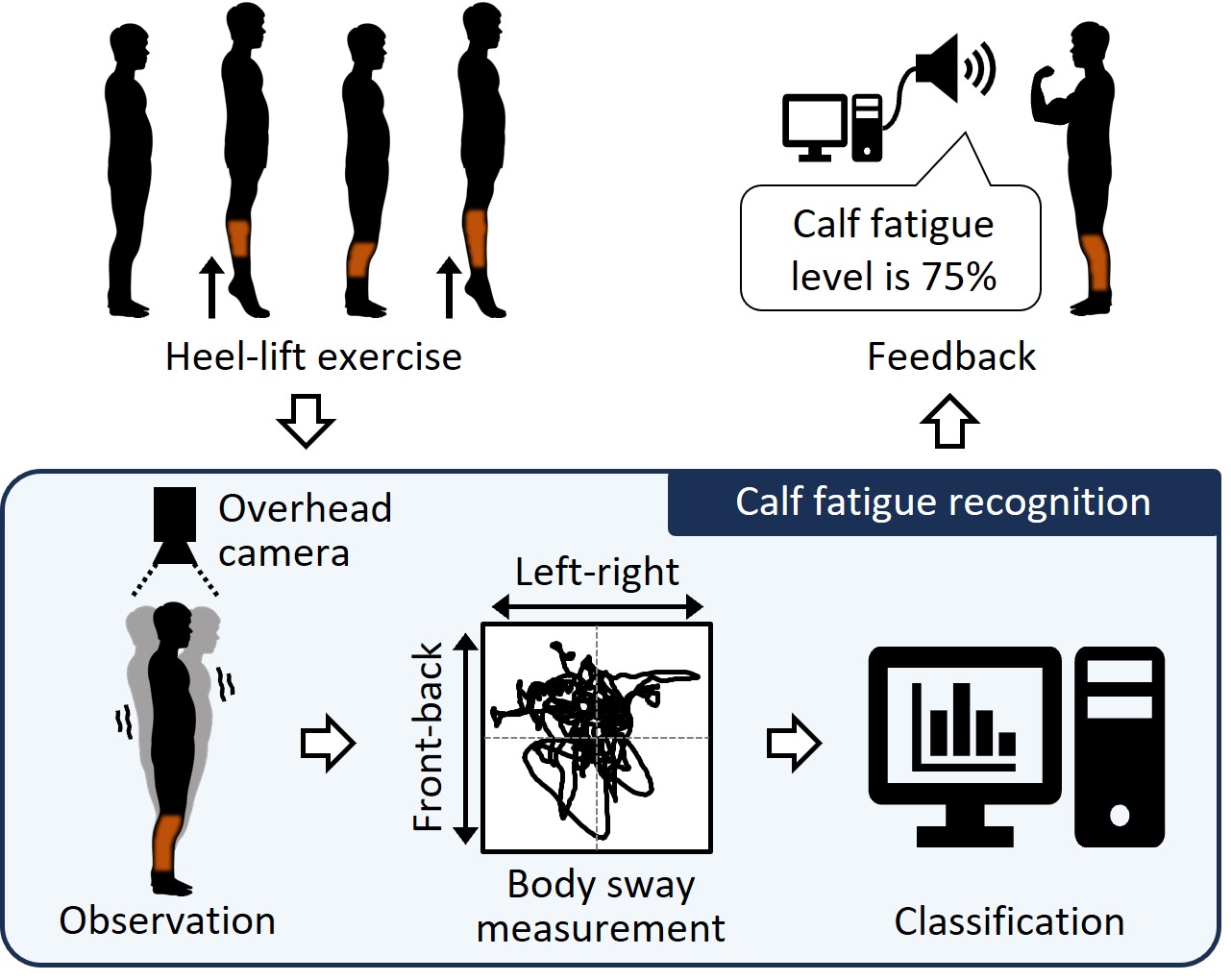
We extract time-series signals of the head center's left–right and front–back movements from body sway recorded by an overhead camera. These features are used to recognize multiple levels of calf fatigue after heel-lift exercise.
Abstract
Even when a person stands still, their body moves slightly. This is called body sway. Earlier studies examined its relationship with calf fatigue using equipment such as a force plate, which measures the force applied by the feet to the floor. We instead investigate whether video recorded after a heel-lift exercise can distinguish five levels of calf fatigue.
An overhead camera records the person. We track how the center of the head moves from side to side and forward and backward over time. Guided by medical knowledge, we extract clues from these movements to identify the fatigue level.
We evaluated the method using 100 videos: five fatigue levels for each of 20 participants. In this experiment, it identified the correct level in 40% of cases, outperforming existing methods designed for human action recognition.
Publications
- Takuya Kamitani, Masaya Kojima, Masashi Nishiyama,
Calf Fatigue Recognition in Heel-lift Exercise Using Video Sequences of Body Sway, Proceedings of 46th Annual International Conference of the IEEE Engineering in Medicine and Biology Society (EMBC), pp. 1 - 4, July 2024. [Poster] - 神谷 卓也, 児島 昌也, 西山 正志,
かかと上げ運動直後に撮影された身体動揺の映像を用いたふくらはぎ負荷認識の検証,
画像センシングシンポジウム (SSII), IS1-09, pp. 1 - 7, June 2023. [Poster] [Short movie]
