Key Points
We use a vision–language model to automatically generate descriptions of the characteristics of each age class and align image and text features through contrastive learning. This improves pedestrian age recognition while reducing the trial and error involved in manually preparing descriptions.
Abstract
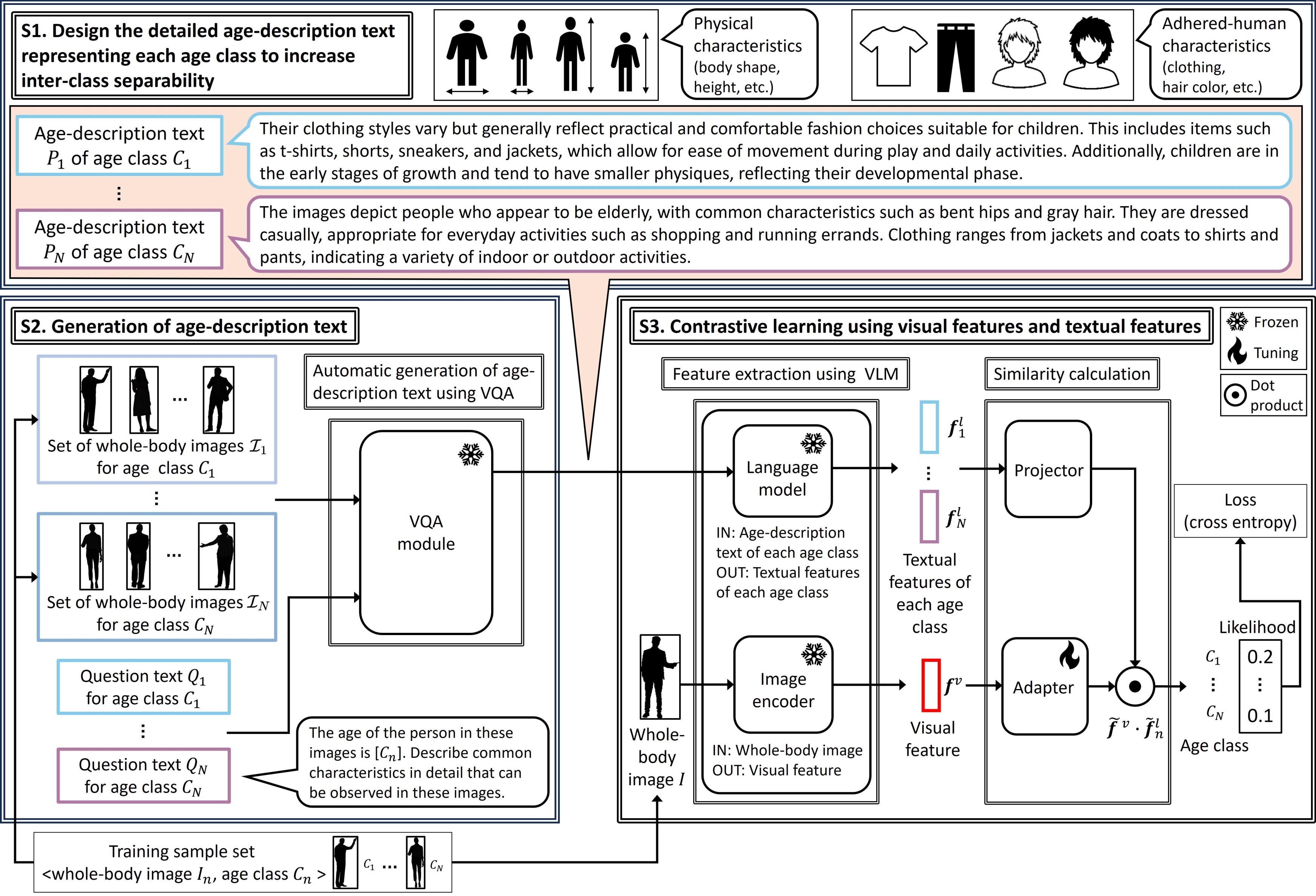
This research aims to identify a person's age group from a whole-body image. AI that handles both images and text can help, but the descriptions of each age group matter. Preparing descriptions that clearly distinguish the groups has required people to repeatedly write and revise them.
We use AI that answers short questions about images to automatically produce descriptions of physical characteristics and things people are wearing. By including more words that express differences between age groups, these descriptions provide useful clues for recognition. We then train the system to match images with descriptions of the same age group. This helps it learn visual clues that distinguish one group from another.
We evaluated the method on four public datasets: RAPv2.0, PETA, MSP60k, and PA100k. It achieved an average accuracy of 84.1%, which was 4.6 percentage points higher than the best method used for comparison. The method also removed the trial-and-error step of manually preparing the descriptions.
Publications
- Takumi Ozaki, Hidenori Kuribayashi, Michiko Inoue, Masashi Nishiyama,
Pedestrian Age Recognition using Contrastive Learning by Automatically Generating Descriptions with High Inter-class Separability, IEEE Access, vol. 13, pp. 146492 - 146502, August 2025. [DOI] - 尾崎 匠, 西山 正志,
年齢認識および性別認識における手法・データセット・クラス不均衡に起因する精度変化の要因調査,
信学技報, vol. 125, no. 424, PRMU2025-60, pp. 102 - 107, March 2026. [Slides] - 尾崎 匠, 栗林 英範, 井上 路子, 西山 正志,
クラス間で良く分離された説明文を自動生成する大規模視覚言語モデルを用いた対照学習による歩行者年齢層認識,
信学技報, vol. 124, no. 445, PRMU2024-54, pp. 47 - 52, March 2025. [Slides] [Short movie]
